A Co-Design Compilation Flow as a Harness for Language Models to Improve It¶
Abstract. We describe a compilation flow that takes an architectural and microarchitectural specification of an accelerator and produces, from that one source, both the RTL and the compiler that targets it — so that a proposed design change yields measured cycles and measured silicon area rather than an estimate. The flow is built on schedule-level design abstractions over MLIR, each of which states a machine property and refuses programs that violate it. We then use the flow as a harness for a language model, and report experiments in which the model is asked not to tune the design but to improve the abstractions themselves. Two independent search arms proposed the same architectural legality rule, and the same unsound form of it, which localises the defect to the shape of the abstraction rather than to either run; we give the corrected shape. Separately we evaluate modelling instructions as compositions of per-unit actions, and report where it pays and what it provably cannot check. Measurements from the flow are given throughout as evidence that its numbers are decision-grade: they reverse two conclusions that cycle-only, single-substrate evaluation had reached. Against Gemmini under an identical standard-cell flow, at matched array size and matched memory capacity, our design is 4.33× larger in logic — and the arithmetic array is under 4% of that logic while the memory-interface adapters are 40.9%, against 6.3% for the comparison design’s entire equivalent path. A structural difference rather than an efficiency gap, and one no FPGA measurement had shown.
1. Introduction¶
Co-design requires a loop, and a loop requires a flow that answers questions about a changed design cheaply enough to ask many of them. The usual obstruction is that cycles and area come from different descriptions: a simulator model, an RTL implementation, and a compiler that targets the machine are written separately and drift apart. A change then costs three edits and a reconciliation, and a language model driving such a loop spends its effort on the reconciliation rather than on the design.
We describe a flow in which one specification generates the machine, the compiler’s model of it, and the checks that hold them together, and in which the design abstractions are legality rules rather than annotations — each refuses a program or a schedule that violates the machine property it states. This makes the flow usable as a harness: a model may edit the specification, or the abstractions, and is answered by measurement.
Contributions:
A spec-driven co-design flow in which architecture, ISA, generated RTL and the mapping compiler derive from one source, with the consistency checked rather than maintained by hand (§2).
Its use as a language-model harness, with the guards and the graded judge that make an agent’s claim checkable rather than plausible (§3).
Experiments on agent-improved abstractions. Two arms, one unseeded, converged on the same architectural legality rule and the same unsoundness; we give the corrected form — a schedule over cycles, not a count over resources (§4).
A measured evaluation of per-unit action composition for defining instructions, including the class of error it cannot detect (§5).
Evidence that the flow’s numbers change decisions: results that reverse what cycle-only and FPGA-only evaluation concluded (§6).
2. The flow¶
Specification. A machine is an architecture — units, channels and memories, each unit declaring the names it reads and writes and the parameters it takes — plus a machine-readable ISA. The architecture is roughly 100 lines composing eight parametrized units. Declarations are not trusted: unit signatures are checked by recomputing free names from the AST and requiring equality with the declaration, and the ISA specification has nine consumers that a checker holds to it. Two configurations (T=4 and T=8) share the same unit objects.
Design abstractions over MLIR. The units are written in a Python accelerator design language whose schedule primitives lower to MLIR. The primitives relevant here each state a machine property and enforce it:
a dependence claim that refuses a provably-false assertion, accepts an unprovable one, and records the residue as an obligation the assembler must discharge;
an encoding constraint making an instruction word’s bit budget a checkable schedule property, re-checked after every later primitive so an error names the primitive that broke it;
memory resource and storage type, lowered to storage bindings in the emitted design;
stream ports on dataflow kernels, with nine legality rules.
Backend and mapper. The same specification drives HLS to RTL, from which cosimulation gives exact cycles, and a standard-cell flow gives area and a timing estimate. A mapping compiler takes a workload as an einsum with extents, dtypes and an epilogue, searches the legal mappings onto the fixed machine, and is graded by a tiered judge: legal (the mapping satisfies the machine’s stated rules), correct (bit-exact against a reference), fast (cycles), with confirmed above fast so an estimate can never select a candidate. Workload specifications are extracted from PyTorch models by tracing and shape propagation only — the existing PyTorch path synthesises a machine for a model and is the wrong direction for this purpose.
What closes the loop. A change to the specification produces a new machine, a new mapping, new cycles and new area, with the consistency of the parts checked by construction rather than by review.
3. The flow as a harness¶
An agent is given the repository, an objective, and a gate ladder; it proposes a diff. The guards that make the resulting claim worth reading were each bought by an observed failure: candidate trees are reconstructed from git with the gate files frozen, so a candidate cannot overwrite the gate that judges it; verdicts are vouched with a nonce, so a candidate cannot print a passing string and exit zero; parametricity and documentation guards exist because a candidate once hard-coded an array dimension and deleted documentation, both of which improved its score.
Two negative results about harness design generalise beyond this system.
A gate ladder that exercises a compiler only through existing designs cannot observe a new capability in either direction. A newly added primitive has no callers, so it is simultaneously unrewardable by the objective and undetectably broken by the gates. This one structural fact explains both halves of a failed run.
Information can be maximally available and still not be used. In a paid run, one candidate’s first iteration rewrote a loop that a comment three lines above it describes precisely: it names the change, names that it was measured, and names why it is worth nothing — the bursts are already hidden behind the sequencer’s prefetch. The agent read the file, kept the comment (a documentation guard requires it), implemented the change anyway, and scored exactly the unchanged cycle count the comment predicted.
This is worth more than the withheld-information version of the same story would have been, because there is nothing to argue about: the information was in-band, adjacent, specific, and retained in the diff. It is a finding about how a model uses what it is given, not about what a harness supplies.
One qualification, offered by its own measurer as a hypothesis rather than a result. The objective asks for fewer cycles, and a decomposed design offers many small local rewrites that look like optimisations. “Merge two loops into one” is locally plausible and globally null, and the reason it is null — a whole-pipeline fact about prefetch — is precisely what a unit-scoped edit is badly placed to weigh. So the decomposition that restored the loop’s reach may also have made locally-plausible nulls easier to propose. n=1, one worker, one iteration; it wants a designed test, not a citation.
Selection must compare against the incumbent, not the baseline. Our keep rule accepted any candidate whose verdict was in the keep set while scoring every candidate against the original design, so all accepted candidates scored alike and a later, worse candidate displaced a genuine improvement (−31% LUT, latency 206→149). Reported improvement counts overstate accordingly, and we report the raw counts with the audit rather than the counts alone.
4. Experiment: can a model improve the abstractions?¶
The question is not whether a model can tune a parameter — it can — but whether it can add an abstraction that lets the language state something about the machine it previously could not.
Setup. Two arms over the same compiler and gate ladder, differing in one respect: one had the target property named in its prompt and a ground-truth pair of designs seeded in its environment; the other had only the measurements. A probe rung graded expressiveness by requiring a candidate to refuse a design the standard-cell flow rejects and accept a bit-exact rewrite of it.
Result. Both arms proposed an architectural legality rule for memory write ports. Both passed the probe. One stated its unchecked premise unprompted. Neither is an annotation: both refuse before modifying the IR.
Both are unsound in the same two directions, found by applying them to cases their authors had not designed for. A block-partitioned array is accepted although both stores land in one bank; an unpipelined two-store loop is refused although its stores occupy different cycles. That an unseeded arm reproduced the defect localises it to the abstraction’s shape:
A predicate over resources is the wrong form for this class of claim. Counting occupants against capacity discards which element is touched in which cycle, and both failure directions recover exactly that discarded information. The sound form is a calendar — an index map composed with the initiation interval — and the IR already carries both.
An independently developed scheduler in an unrelated accelerator is immune to both directions because its port model is a set of cycles rather than a count. Its authors observe that they also lack the banking that makes the error possible, so the finding is predictive — the defect arrives with banking — rather than a comparison of care.
What this does not show. The property was seeded in one arm, and the other chose the most salient measurement available to it. Neither demonstrates that a model can find an architectural gap unaided; an earlier arm reached repeatedly for a surface that already existed, adding a new spelling rather than a new capability. One arm also arrived at a correct artefact through a factually wrong diagnosis: the port count was already declarable, and only enforcement was missing.
5. Experiment: instructions as compositions of per-unit actions¶
If an instruction is a declaration rather than a diff over a compiler, the move set available to a search changes shape. We tested this directly by defining an instruction as a sequence of per-unit actions and adding one new fused instruction both ways, on otherwise identical trees, with the shared hardware change cherry-picked identically into both so only the difference is measured.
Cost. +79/−1 lines in one file with actions, against +77/−6 across three files without. It does not reduce code. What it reduces is the number of independent statements that must agree: five specification regions plus two consumers, down to one region plus one declared hardware fact. Two of the replaced restatements were already wrong, and a third consumer deadlocked on first contact with the new instruction, which is how its staleness surfaced.
The discriminating test. Two actions, each legal in an instruction of its own, compose into an instruction that is not: two units writing one port in one cycle. The model refuses it, and the repair is a cycle offset, not a port. A count cannot refuse this — the count is one write per unit, and one port per unit is what the machine has. This is the predicate/calendar distinction of §4, reached independently and by a different route.
What it cannot check. Of fifteen deliberately incorrect declarations, five are refused structurally and four are caught by a cost check; six are invisible to every static check — an action naming the wrong operand, subtraction where addition was meant. The model verifies composition, not arithmetic. A control mutant that changes nothing is correctly not caught, which is what shows the harness ran the file it was given.
5.1 Can the behavioural model be derived from the structural one? The two descriptions were written independently: a compose unit declares what names a body needs from outside, an actions unit declares what effect lands where and when. If the second can be derived from the first, an Action becomes an annotation on an existing model rather than a second declaration of every unit. We built the derivation and made the diff a gate.
Of 28 ports the Action model declares, 24 stop being independent: 20 are the architecture’s own channels and memories, read off the same AST the structural checker already parses, and 4 more stand for them. Two units derive completely. The residue is exactly the interesting part:
3 are arithmetic — a multiplexer, a multiply-accumulate, an ALU. No composition can carry these: they are what a unit does, not what it is connected to.
1 counts instructions and corresponds to nothing physical.
The control path cannot be an action at all. A unit reads its dispatch queue inside a step it is already spending; an action is per-row or per-instruction, and the per-instruction form adds a head step to the work count the instruction header carries. Measured rather than asserted: one instruction’s cost goes from 6 to 7.
The derivation found three on-chip memories the Action model never had — real state, invisible to the ISA because no instruction field names a row of them.
And the load-bearing finding: the two models do not agree on what a unit is. A compose unit is a kernel, replicated by an instance count. An actions unit is a dispatch domain, one work counter. They are the same object for seven of eight units and a different object for the array, where T×T kernels are one dispatch domain the ISA calls array. No naming convention closes that: a header field counts rows per instance across T×T kernels, and the behavioural model has no word for the distinction.
5.2 The two defects the second machine exposed, and what fixing them cost.
Lane width was previously read off a shadow one-row state, because a lane map
seemed to need addressed storage. It does not: giving the structural
Channel a lane count and deriving its element type from it removes the
shadow state entirely, and a fold takes its operand width from the channel the
value arrived on. The missing thing was a lane count, not addressed state —
a channel has no rows, no bank map and no collision rule, and a fold needs none
of them.
The work model charged latency as occupancy, reporting 80 steps where the hardware does 16. Separating an action’s span (which a declared latency lengthens) from its initiation (the busiest resource a row books, read off ports already declared) gives 16, leaves the calendar unchanged, and declares nothing new. Every count on the first machine is unchanged, because a unit with no declared latency has span equal to initiation — which is why one machine could never have shown the defect.
It cost a static catch, and we kept the loss visible. One deliberately wrong declaration — an ALU declared one lane operation per step instead of two — was previously caught by the cost check because of the defect: the broken model pushed the work into a third cycle. Correctly pipelined, the accumulator’s single read port binds at two per row either way, so no work count can see the ALU’s width. The fifteen-mutant split moves from 5 / 4 / 6 to 5 refused structurally, 3 caught by cost, 6 invisible, 1 caught by nothing.
5.3 Consolidation: not one file, and the reason is a result. The intended end state was a single file. It should not be, on two independent grounds. First, the behavioural model imports nothing from the compiler, and that independence is what lets an ISA be composed and checked without the front end; merging would make it depend on the dataflow layer and on MLIR bindings for no new capability. Second, the specification’s discipline is that the spec is the source of truth and the design is held to it — a spec that reads its ports out of the design cannot check the design’s ports.
What is available, and what we built, is a checked projection: where the two models overlap they can no longer drift, and where they cannot overlap the reason is written down and checked in both directions. Two architectures now compose, and the second one’s behavioural model is derived rather than written.
So the end state is reachable in a modified form, and the modification is the finding: `Unit` means two different things, and one file would mean one of the two meanings silently winning.
Recommendation. Worth using where several consumers would otherwise restate one per-unit fact; not a default, because one machine has exercised it. This is directed work, not a search result, and is reported as such.
6. Do the flow’s numbers change decisions?¶
Three results, each of which reverses or reframes a conclusion that a cheaper evaluation had reached.
6.1 Speed, against a matched baseline. Against Gemmini at matched array dimension, measured over the same window with host overhead treated symmetrically, the deficit converges rather than growing — 1.27× at 16³ to 1.09× at 64³, at 74.1% of peak — with the residual localised to a fixed DMA prologue worth 55–61% of it. At T=8 on one shape we are 1.18× faster, clearing the comparison’s spread by 4.8×. A second team measuring an unrelated design independently found the same shape of loss, supporting the joint conclusion that the advantage at these sizes is software, not array. Our cosimulation is deterministic; the spread in the tables is the comparison’s.
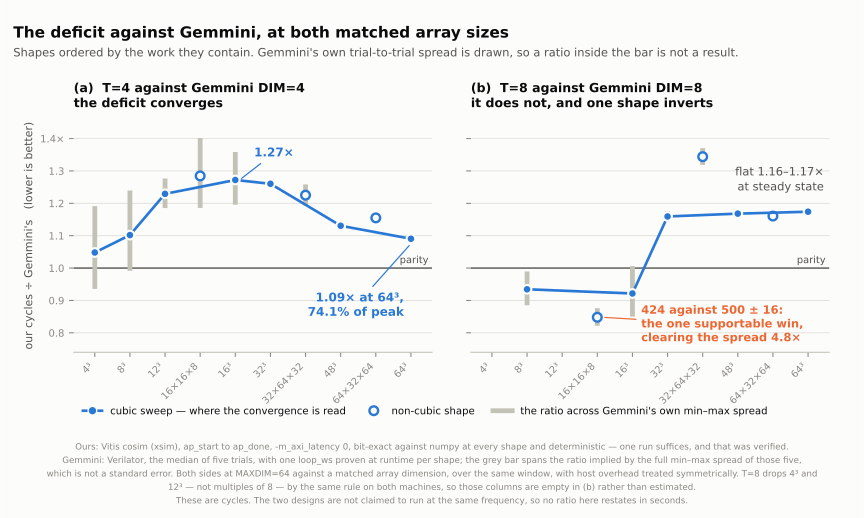
The deficit converges at one matched size and does not at the other.
Cycles, not seconds: ours from Vitis cosim, bit-exact and deterministic;
Gemmini the median of five Verilator trials, with the grey bar spanning the
ratio implied by that spread. Drawn by docs/figures/gemmini_figures.py
from the tables in The Benchmark Set, cross-checked against the
copy in examples/tinytpu/parity_sweep.py.¶
6.2 The substrates disagree, and the FPGA is the misleading one. An optimisation that recovers much of the deficit appears inexpensive on FPGA. In 45 nm it costs +74.4% cell area, and hierarchical attribution places 99.1% of the delta in two AXI master ports, which grow 13× when widened; the scratchpad, vector registers and accumulator do not move. The FPGA reported +43% flip-flops and +92% block RAM — the block-RAM axis being exactly the buffering that dominates in standard cells.
Separately, the instruction-fetch adapter is 60.0% of the baseline design, against 1.1% for the scratchpad and 2.9% for the sequencer, and is constant across all four synthesised variants — independent evidence that it is infrastructure rather than part of the machine. This is not idiosyncratic: Gemmini’s published breakdown reports SRAM at 67.1% of accelerator area and the spatial array at 11.3%. A third instance: a dual-write-port buffer is free on FPGA block RAM and is rejected outright by the standard-cell flow, while a banked rewrite preserves every cycle.
6.2c The comparison, measured. Gemmini DIM=4 and our T=4 MAXDIM=64 are now synthesised under an identical flow, with every parameter compared and the standard-cell library matched by checksum rather than assumed.
Logic-only, Gemmini is 382,026 µm² and we are 3.66× that; full against full, 1.88×. But the shape differs more than the size, and the shape is the result:
Gemmini DIM=4 |
ours (T=4) |
|
|---|---|---|
memory-interface / adapter logic |
23,885 µm² (6.3%) |
840,160 µm² (60.2%) |
non-combinational share of logic |
38.3% |
80.1% |
We are 3.66× larger in logic, and roughly 35× of that difference is in the memory interface alone. Our four AXI masters are 60.2% of our logic; their TileLink reader, writer and transaction-tracker path is 6.3% of theirs. This is a structural difference rather than an efficiency gap — TileLink at this width does not produce this structure — and it is §6.2’s finding arriving from the comparison rather than from our own hierarchy.
6.2d The shape difference, at two sizes. Gemmini DIM=8 logic-only is 524,402 µm², timing met, same flow and same stub rule. Two readings follow, and the second is the one that does not depend on any argument we could be accused of choosing.
Doubling the mesh costs +37.3% of logic (382,026 → 524,402) for 4× the PEs — sub-linear, which is what one expects when control and the memory path dominate rather than the array. That is the adapter finding of §6.2 arriving from the opposite direction, on someone else’s design.
And the non-combinational share is stable and opposite on the two designs:
Gemmini DIM=4 |
Gemmini DIM=8 |
ours, every run |
|
|---|---|---|---|
non-combinational share of logic |
38.3% |
37.2% |
≈80% |
Their logic is gate-heavy; ours is flop-heavy, at both sizes. No node scaling, no capacity matching and no exclusion rule enters that comparison; it is a share of each design’s own logic.
Corrected after the full DIM=8 run. An earlier version of this paragraph added “and regardless of the memory treatment”, which is true of our design and false of theirs: with memories rendered as flip-flops their share moves from 37.2% to 60.7%, while ours is ≈80% either way. So the substrate distortion is larger for their design than for ours — the opposite of what we expected — and the gate-versus-flop statement holds on the logic-only pair only. It is stated that way now. It is therefore a structural statement about what HLS emits versus what a Chisel generator emits, not about either accelerator, and it is the most transferable result the area track produced.
A caution that belongs beside the frequency numbers. Gemmini DIM=8’s worst path group closes at exactly 0.00 ns — zero violating paths, zero hold, a genuine pass, but with nothing spare, against +0.20 to +0.21 ns on every one of ours. It must be written as “closes at 3.33 ns” and never as headroom: a 0.00 that reads as “met” in a table becomes “both close at 3.33 ns, equally” in prose. If a frequency comparison is ever attempted, Gemmini’s is the number that moves first.
6.2e One change, measured two ways. Gemmini DIM=8 full is 1,138,578 µm², against 990,938 at DIM=4 — +14.9% for doubling the mesh. The logic-only pair gives +37.3% for the same change. The stubbed scratchpad and accumulator are 53.9% of the full figure, and that mass is insensitive to the mesh, so it dilutes the delta.
The same design change reads as +14.9% or +37.3% depending only on how the memories were treated. That is the strongest argument in this work for quoting the logic-only pair — stronger than the gate-versus-flop share above, because it is one change measured two ways rather than an inference about which component dominates.
And that run misses timing, the only one in the set that does not close: worst slack −0.01 ns on a 3.33 ns target, 80 violating paths in a 491,512-cell design. Per the methodology fixed before any number existed, this is reported as “the comparison design’s RTL was not targeted at this constraint”, not as “it is slower”: 0.3% of the period is what a longer period, a higher effort or a retarget would absorb, and a synthesis-stage estimate is a floor rather than an achieved frequency. The miss is stated and the inference refused.
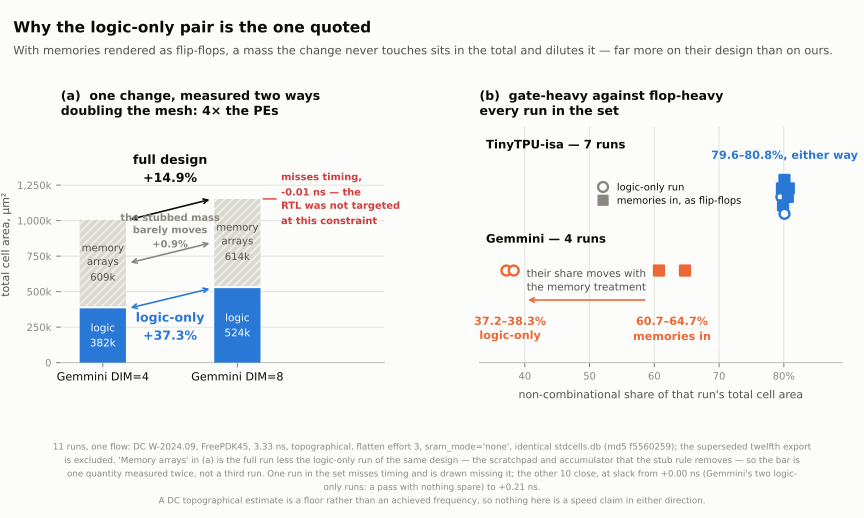
The memory treatment decides the answer, and it decides it for their design more than for ours. The stubbed mass barely moves with the mesh, so it dilutes the full-design delta; and it moves their non-combinational share by more than twenty points while leaving ours where it was. The run that misses timing is drawn missing it — a DC topographical estimate is a floor, not an achieved frequency, so no speed follows in either direction.¶
6.2f The matched pair, and where the difference goes. Eleven runs under one flow — DC W-2024.09, FreePDK45, 3.33 ns, topographical, flatten effort 3 — give the comparison this section was built for. Our T=8/MAXDIM=64 at QD=16 against Gemmini DIM=8, logic-only, capacities matched to 2%, same library, same clock, same exclusion rule, both closing timing:
2,272,572 µm² against 524,402 µm² — 4.33×
And it is not compute. Hierarchical attribution of our logic:
component |
µm² |
share of our logic |
|---|---|---|
instruction-fetch adapter |
697,974 |
30.7% |
DMA load unit |
372,150 |
16.4% |
two operand adapters |
102,105 + 102,101 |
9.0% |
output adapter |
27,334 |
1.2% |
sequencer |
33,516 |
1.5% |
the 64-PE array |
≈ 84,700 |
≈ 3.7% |
The four memory-interface adapters are 40.9% of our logic, 57.3% with the DMA unit; the array that does the arithmetic is under 4%. Gemmini’s entire reader/writer/transaction path is 23,885 µm² — 6.3% of its logic at DIM=4, which is the design point that attribution was measured on; the matched-capacity totals above are ours against DIM=8, so the two are not the same run and the share is quoted as the order it establishes rather than as a paired figure. So the 4.33× is memory-interface mass that TileLink at this width does not produce, measured at matched capacity with both sides’ cycles taken from the RTL that was synthesised. It is §6.2’s finding at a second design point, and this time it is the headline rather than an inference.
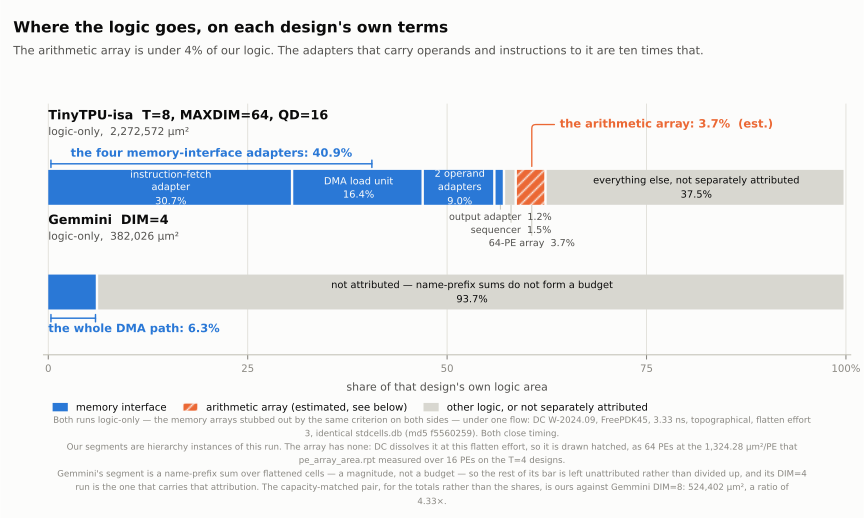
The 4.33× is not compute. Shares of each design’s own logic, both runs logic-only under the same flow and the same stub rule. Our segments are hierarchy instances of the run; the array has no hierarchy line at this flatten effort, so it is an estimate from the measured per-PE area and is drawn hatched. Gemmini’s segment is a name-prefix sum over flattened cells — a magnitude, not a budget — so the remainder of its bar is left unattributed, and its DIM=4 run is the one that carries that attribution.¶
Why the logic-only pair and not the full one, as a measurement rather than an argument. The stubbed arrays are 19.8% of our full figure and 53.9% of theirs — their design is far more memory-dominated once memories become flip-flops, so the full-design ratio of 2.49× understates the logic difference by an amount that is purely an artefact of the memory treatment. Together with §6.2e’s same change, two ways, that is the whole case for quoting logic-only, and neither half of it is an opinion about which component matters.
Two numbers deliberately not claimed, because each would mix two compiler commits:
+62.7% for T=4 to T=8 logic-only. It compares a QD=16 export against a QD=8 one, so it bounds the cost of doubling T rather than measuring it. A clean figure needs both variants emitted from one commit.
+14.2% between the two T=8 full runs as the price of channel depth. Same defect, and it bounds from above. An earlier version of this paragraph set it against +0.9% flip-flops on the FPGA and called the gap a third instance of the resource table understating silicon. That inference was wrong: the same pair cannot be confounded for area and authoritative for the comparison, and the run’s own report says it must not be quoted as the depth cost. The figures that are comparable, at the scored design point, are +9.5% flip-flops on FPGA against +6.6% cell area — so at that point the FPGA table does not understate, and the claim is withdrawn rather than repaired.
Two methodological points are now settled on evidence rather than argument. First, the exclusion of our instruction-fetch adapter: no cells inside the Gemmini boundary match instruction fetch at all. What exists is command queue and decode for commands arriving over RoCC, 31,715 µm². The symmetry argument holds because the structure is genuinely absent, not because we assumed so. Second, the one arguable cut — the DMA’s address-translation block, kept in because removing it would mean editing their RTL — is under 1.1% of their logic either way it is counted, so the ambiguity was immaterial.
As with the PE array, DC’s flattening leaves these as name-prefix sums rather than hierarchy lines, and the committed reports state that limit.
6.2a What can be compared before the comparison design is synthesised. Our own runs are complete and the comparison design’s are not, but two comparisons are available now from its published figures, and they differ sharply in what they support.
Structural, and node-independent. Gemmini’s published breakdown (Intel 22 nm, 16×16 int8, 256 KB scratchpad, 64 KB accumulator) gives memory 67.1% of accelerator area and the spatial array 11.3%. Our baseline (FreePDK45, 4×4, flip-flop memories) gives the instruction-fetch adapter 60.0% and non-combinational cells 79.7% of total area. These are fractions of each design’s own total, so no node or capacity scaling is involved, and they agree on the conclusion that matters:
On both designs the arithmetic is a small minority of the silicon. The majority is state and supply — SRAM capacity in one case, instruction supply and register-resident state in the other — and the two designs reach that condition by entirely different routes.
That is the substrate-disagreement result of §6.2 restated from an independent source: the component a designer optimises is not the component that sets the area.
Absolute, and only as a sanity check. Gemmini’s accelerator-only total is 858K µm² at 22 nm (1,029K less the 171K host-CPU line their table reports separately). Ours is 1,137K µm² at 45 nm, or 455K excluding instruction supply. A crude standard-cell node scaling of 45 nm to 22 nm is roughly 3–4×, which places our comparable figure an order of magnitude below theirs — as it should be, for a 16-PE machine with 2.5 KiB of local memory against a 256-PE machine with 320 KB. We report this only as confirmation that nothing is wildly wrong. It is not an area-efficiency claim: the configurations differ by 16× in PE count and 128× in memory capacity, the memories are flip-flops on our side and SRAM macros on theirs, their figure includes place-and-route and ours does not, and the node factor is the dominant uncertainty.
What is still missing, and why it is the useful one. A per-PE comparison of the arithmetic array alone would be free of the memory-technology difference entirely, since the array is pure logic on both sides — Gemmini’s published figure is 453 µm² per PE at 22 nm. Our per-instance array area is not in the committed reports, so this comparison is one hierarchical area report away and is the first thing to extract when the queued runs execute.
6.2b Two further instances, from an independent design. The same pattern was found in an unrelated FPGA accelerator by its own team, auditing for ASIC readiness. It has ~63,632 bits held in LUT shift registers, 15,616 of them deliberately — one module withholds a payload reset specifically so its delay line stays a pure shift register. A standard-cell flow has no such primitive, so every one of those bits becomes a flip-flop, and none of it is visible in a LUT count. It also holds 512 KiB of lookup tables initialised by ``$readmemh`` across 64 instances, likewise with no standard-cell equivalent. Their total on-chip storage is ~1.08 MiB against the ~10 KiB in the variant we measured at 79.7% non-combinational area, so our figure is the one they now use to predict their own outcome.
This is the same class as the dual-write-port buffer of §6.2 — a primitive that is free on one substrate and absent on the other — found independently, in a different design, by a different team, and it raises the count of such structures to four.
A related figure was corrected twice in one day by its own side, and the second correction is the methodologically interesting one. That team’s per-launch overhead, published by us as host software, is mostly the device reloading its own instruction memory (~81% of the cost removed by reducing launch count). The remaining ~30 µs register path was then attributed to bus latency — and, measured against a no-bus control (identical driver code against a plain buffer instead of the mapped device), the bus is 0.442 µs and the rest is the interpreter. The original error was timing single operations with a timer that costs more than the operation, and the tell was that the control measured slower than the real thing. Each correction made that side’s position worse, and the second one invalidated a fix they had planned, which could not have recovered more than 0.44 µs. Instruction supply turns out to dominate both machines in different currencies — 60.0% of our silicon area, and the majority of their per-launch time.
6.3 The workload class changes the answer by four to eight times. On GEMM shapes the same optimisation is worth 4.3–7.0% of runtime; on multi-layer models, 25–34%. A model does not make the problem larger, it makes it longer, so a fixed per-call cost is repaid at every layer rather than amortised by one large problem. An optimisation ranked on GEMM shapes is ranked on the workload least sensitive to the cost it removes. Three instrument errors surfaced only under the model suite, including an analytic cycle estimator 26–36% low against the shipped build.
6.4 A threshold the model could not see. Three legal tiled programs never complete at the shipped channel depth and all complete bit-exact at twice that depth — same tree, same toolchain, one knob — with the published shapes moving +4/+4/+4/−1/−11, the largest getting faster because a deeper queue lets the sequencer run ahead. The cure is not a characterisation: the obvious counting rule is refuted by our own shipped program, and our Kahn-process model pronounces these deadlock-free because it does not model a unit blocking mid-instruction across the queues one instruction fans out to. This is a stated gap in the flow, not a solved problem.
7. Threats to validity¶
The area comparison covers one design point. Gemmini DIM=4 and our T=4 MAXDIM=64 are synthesised under an identical flow; DIM=8 and the capacity-matched pair are not run, so no total-area claim is made and the result is logic-only. DC’s auto-ungrouping dissolves instance hierarchy at the effort these runs use, and no reporting option recovers it — recovering it requires changing synthesis, which would break comparability with every run already done. The component figures are therefore sums over a name-based selection of flattened leaf cells.
That method was validated rather than assumed. For a block whose boundary did survive, the hierarchy line reports 705,486.0 and summing the 230,892 flattened leaf cells beneath it gives 705,485.998 — identical to the digit. So the arithmetic is exact and the only uncertainty is selection: whether a cell named for one unit belongs to it, and whether logic merged across a boundary was renamed away. On our side the selection is clean (every matched cell accounted for, and the per-unit distribution reproducing across two independent designs to the digit); on the comparison design it rests on the generator’s naming surviving flattening, which is the weaker of the two and is stated as such.
Area results use flip-flop memories rather than SRAM macros, which inflates memory-resident structures; it does not flatter the adapter findings, which are the ones we rely on. Power is reported nowhere: without macros and place-and-route it would be dominated by clock power into flip-flop arrays and estimated wire capacitance, both larger than the effect under study, so activity annotation would remove one of three objections and leave two.
§4 is two arms and one seeded property, without unseeded replication. §5 is one machine and one new instruction, with the demonstrating instruction chosen by the abstraction’s author.
Cycles and area are joined by declaration, not by proximity. Cycle counts
come from Vitis cosim and area from Design Compiler. Each flow is internally
consistent, so each flow’s own check passes while the join between them can
be wrong, and the errors this work made most often lived exactly there. We
therefore treat a cycle count and an area figure as describing one machine only
when one of two conditions holds, and a checker
(allo/backend/asic/tools/check_pairing.py) decides which: either both cite
the same committed RTL export, verified by the manifest checksum the
synthesis run recorded, in which case their configuration agrees by
construction; or both declare every configuration parameter — T,
MAXDIM, QD, DMA_WORDS — and the four agree. A parameter that is
absent on either side is treated as cannot pair, never as a match, because
the exports predating a parameter record nothing about it and the default at
the time was usually not today’s.
Applying that rule to this repository refuses more than it admits, and two of
the refusals are results rather than formalities. No model-level cycle count
can currently be paired with any committed area figure: the workload numbers
were measured at QD=16 and every committed TinyTPU export was emitted
before QD=16 became the default and records no QD, so the end-to-end
claim reaches cycles and stops. And the T=8 area is orphaned: the
export it was synthesised from was re-emitted two days later, so the RTL a
reader finds at that path is not the RTL that area describes. Neither fact was
visible to any single-flow check; both were produced by the join.
Instrument failures. Four instruments were observed reporting success without having run: a tool server that answered without binding, a cost meter reporting zero for a billed call, a self-consistent manifest describing a truncated export, and a leak detector that crashed and was read as clean. Three further checks ran against the wrong object and passed: an incremental documentation build that skips the files it was meant to inspect, a simulation run at a different configuration than the one claimed, and a repository check reading commit titles rather than contents. We therefore treat a negative result as evidence only when the instrument can be shown to have run, on the object being claimed — and we report that rule here because it changed which of our own results we were willing to keep.
A second rule, from the correction in §6.2b: attributing a cost requires a control that shares everything but the mechanism under test. A measurement can be accurate and still attribute its result to the wrong cause, and the error is invisible from inside the measurement. The tell in that case was that the control came out slower than the thing it controlled for.
8. Conclusion¶
A co-design flow whose machine, compiler and checks derive from one specification is usable as a harness: a language model can be pointed at the abstractions rather than at the parameters, and answered by measurement. Doing so produced an architectural legality rule twice over, independently, together with the same unsoundness — which is more informative than either arm alone, because it identifies the defect as belonging to the abstraction’s shape rather than to a run. The corrected shape is a schedule over cycles, and the same distinction reappears when instructions are modelled as compositions of per-unit actions. Whether that modelling generalises is decided by a second machine, which is the next experiment; and the flow’s own numbers are worth having chiefly because they reversed two conclusions we had already drawn without them.